Patient context that follows every consultation.
Healthcare AI works best when it knows the patient. Not just today's complaint, but their history, their medications, their preferences, and what they've tried before and how it went. Hebbrix gives your AI agents the persistent, privacy-respecting memory that makes that possible.
Healthcare use requires a security and legal review. Do not submit PHI unless Hebbrix and your organization have signed a BAA and confirmed the exact supported scope. Encrypted at rest and in transit.
What a healthcare agent knows before the first message
Before responding to a patient inquiry, Hebbrix loads their longitudinal context, built from every prior interaction and structured automatically.
Every appointment note, message, and medication update adds to the patient's context. There is no manual data entry into the AI system, since it learns from the interactions that already happen.
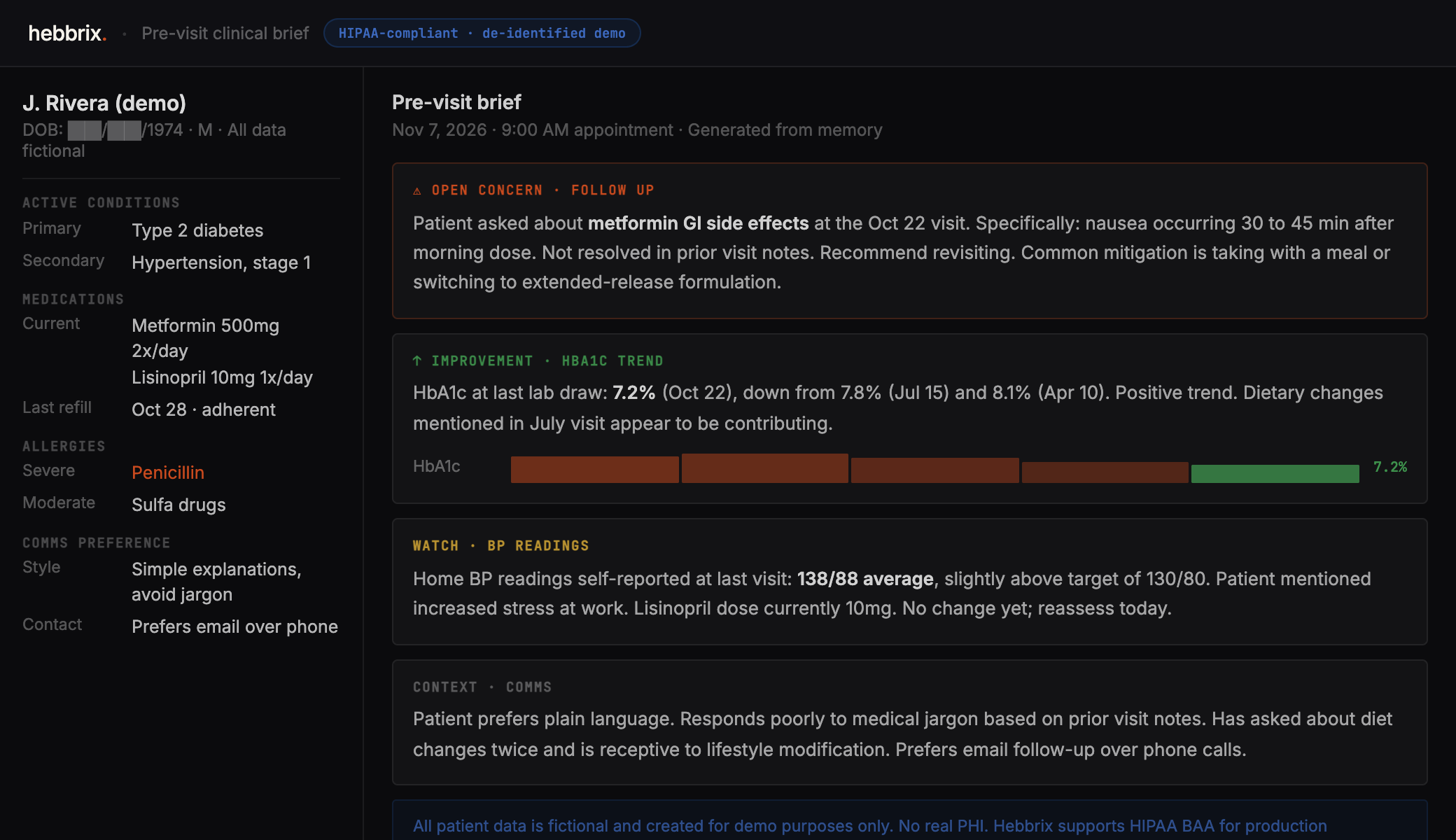
Take the unresolved metformin question from October. When the patient messages in November, the agent knows to revisit it, so the patient never has to raise it again.
Allergy information persists across every interaction. When a question about a new medication comes up, the agent already knows what to watch for.
Memory-powered healthcare AI, in practice
Patient triage
Route patients based on full history, not just today's complaint. Context changes the urgency.
Medication support
Answer questions about current medications with full knowledge of the patient's other prescriptions and allergies.
Chronic condition management
Track HbA1c trends, blood pressure readings, and medication adherence across every check-in.
Care coordination
Every member of the care team works from the same complete patient context, with no information silos between them.
Appointment preparation
Generate briefs for providers that surface unresolved concerns, significant changes, and patient preferences.
Follow-up automation
Personalized follow-up that references the specific things discussed in the last appointment, not a generic template.
Built with healthcare compliance in mind
Contact us before using regulated data. Do not submit PHI unless a BAA and the required security terms have been signed.
Collections ensure each patient's data is completely isolated. No cross-patient memory leakage.
Encryption at rest and in transit is not HIPAA compliance or a SOC 2 attestation. Request current security evidence.
Patient context that persists
Talk to us about your healthcare AI project. We'll walk you through compliance, architecture, and a path to production.