Your agent forgets everything after every session. Fix that.
A versioned memory system built for production AI agents. Adaptive hybrid retrieval, temporal knowledge graphs, confidence metadata, and explicit Outcome Memory are available through one API.
How each agent interaction can inform the next
Memory here is an inspectable loop, not a filing cabinet. Conversations can update durable facts; separately reported action outcomes can improve future choices without inventing feedback.
Four capabilities that turn a stateless agent into one that remembers
Each one solves a specific problem. Together they give your agent a working memory it can actually reason over.
Current truth and retained history
Temporal validity, provenance, supersession chains, operational lifecycle tiers, and explicit deletion controls keep current answers auditable.
Adaptive evidence, one query
Dense, sparse, graph, temporal, facet, and calibrated ranking signals adapt to each query and expose confidence and degraded-mode metadata.
Relationships, not just facts
Smart ingestion extracts entities and relationships with source-memory and temporal provenance, while manual graph APIs support controlled schemas and corrections.
Learns from reported results
Record candidate actions and propensity before acting, then report delayed outcomes. Hebbrix maintains posterior evidence, uncertainty, corrections, and idempotency.
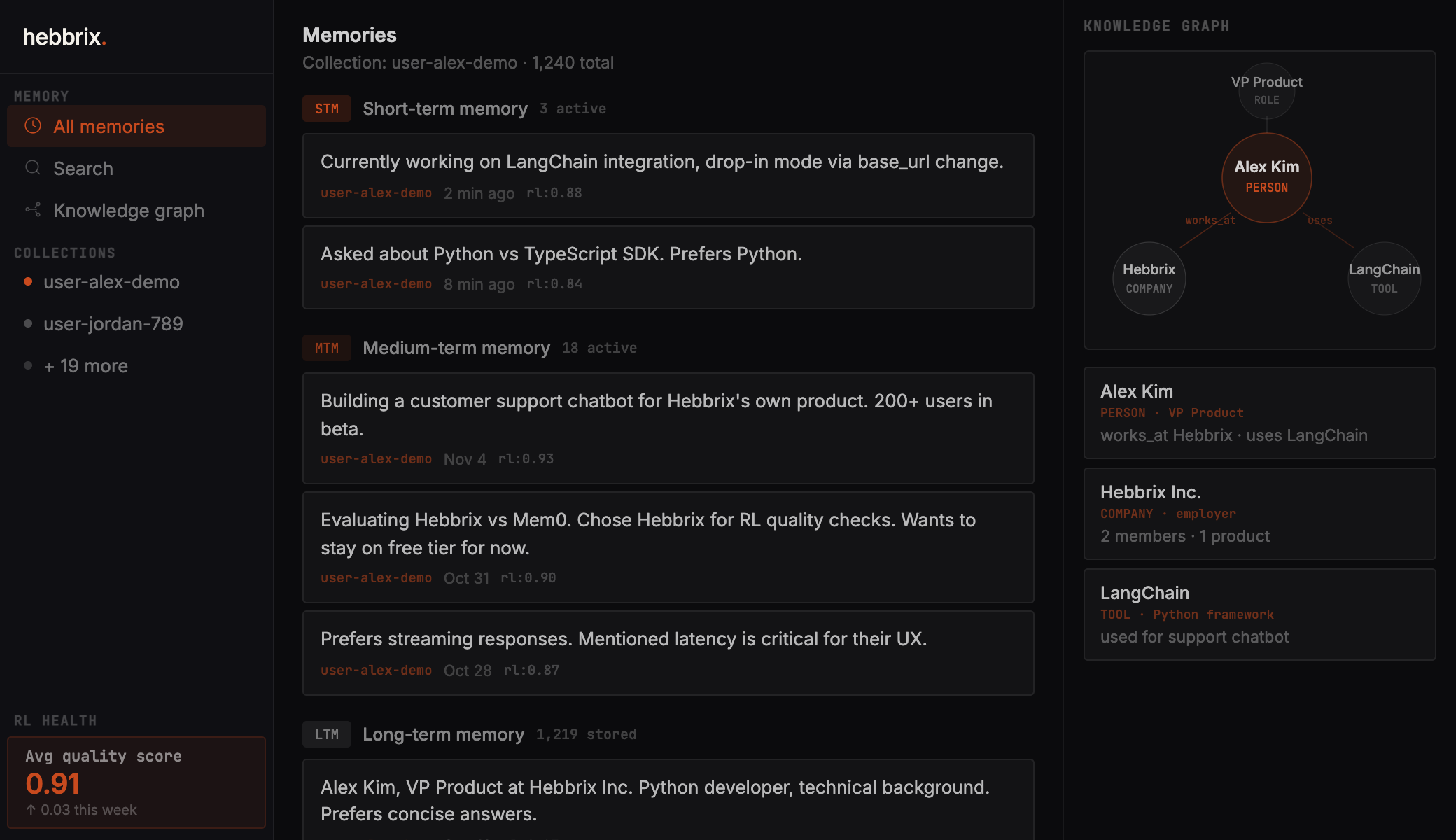
Same memory API, every architecture
Support bots, assistants, sales agents that remember every customer interaction.
Agents that know your codebase conventions, past decisions, and architecture patterns.
Synthesize information across sources. The knowledge graph reveals hidden connections.
Multiple agents sharing memory through collections, each with its own scope.
Hebbrix is OpenAI-compatible
If your agent already uses the OpenAI SDK, add persistent memory by changing two lines: the base URL and API key. Your agent, your prompts, and your tools all stay exactly as they are.
from hebbrix import MemoryClient

async with MemoryClient(api_key="YOUR_API_KEY") as client:
    # Store something your agent learned
    await client.memories.create(
        content="Sarah prefers Python, works at Acme Corp",
        collection_id="user-sarah-123"
    )

    # Next session: instant recall
    results = await client.search(
        "What does Sarah work on?",
        collection_id="user-sarah-123"
    )
# → "Sarah prefers Python, works at Acme Corp"
# → Entity: Sarah → Acme Corp (employee)
Give your agent the memory it deserves
Generous free tier, no credit card. Enough to build a production prototype and decide if memory is worth it.