Vector search finds text. Graph RAG finds connections.
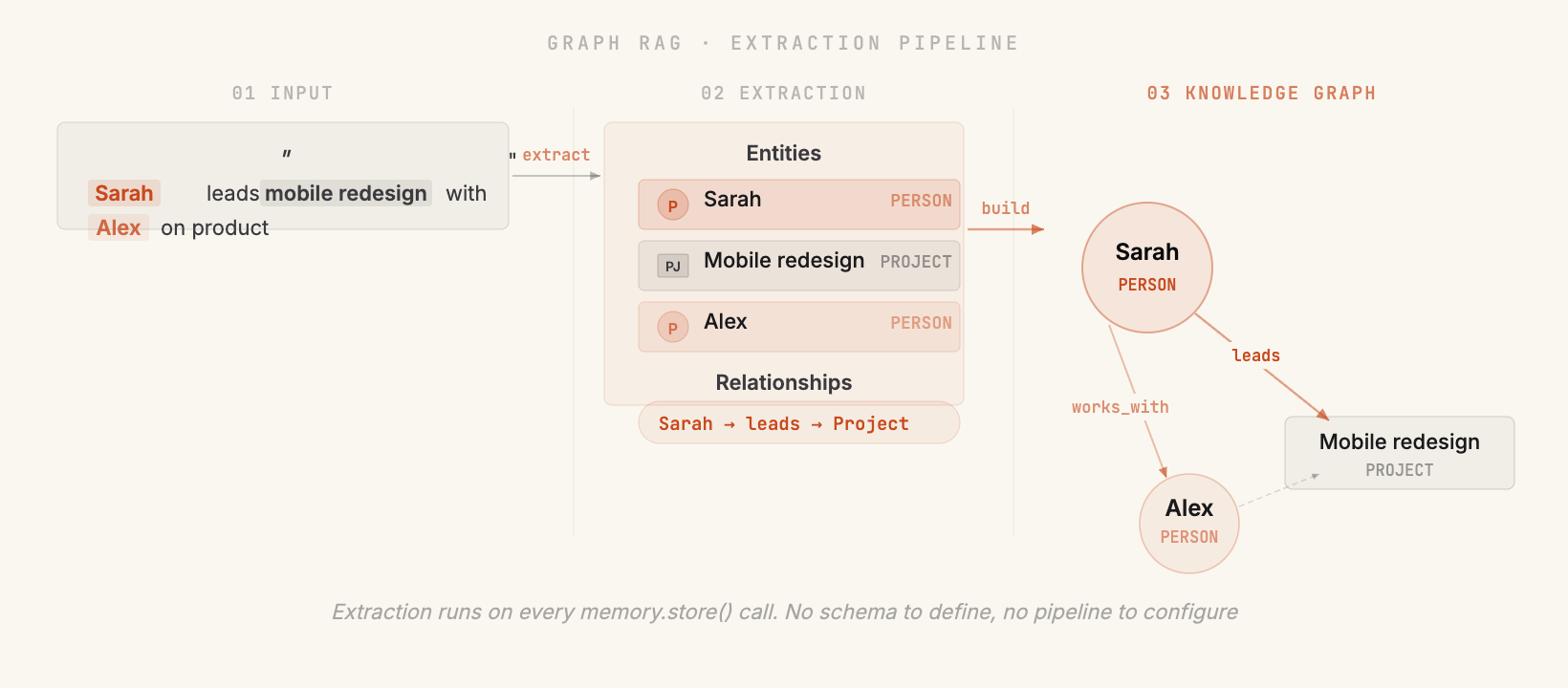
Hebbrix pulls the entities and relationships out of every memory you store. When your agent searches, it doesn't stop at matching embeddings. It walks the graph and finds answers that flat retrieval would miss entirely. You don't define a schema. You don't write extraction rules.
Same question. Completely different answer quality.
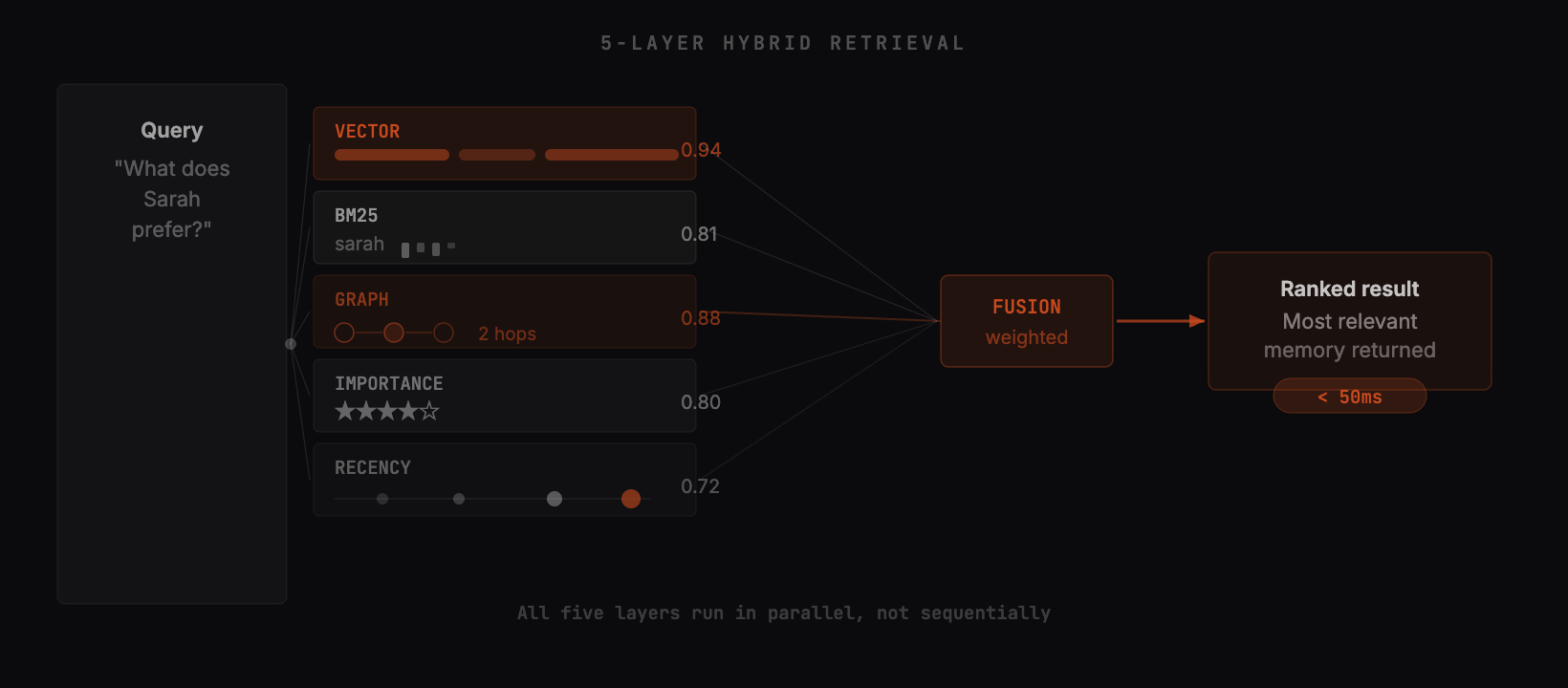
Vector similarity finds memories that sound like your query. Relationship traversal finds answers your query never explicitly asked for, because that knowledge lives in the structure, not the text.
Store text. Graph builds itself.
Smart ingestion can extract typed entities and relationships from plain language. Manual entity and relationship APIs, source provenance, timelines, and contradiction queries provide control when schema quality matters.
No schema to define
Person, project, company, concept: Hebbrix recognizes them all on its own. You name the entities in plain English.
Graph grows with usage
Every memory adds nodes and edges. The more your agent learns, the richer the graph becomes.
Queryable directly
Use POST /v1/knowledge-graph/query for temporal relationship lookup, or request graph evidence through hybrid search.
from hebbrix import MemoryClient

async with MemoryClient(api_key="YOUR_API_KEY") as mem:
    # Store plain text. No schema needed.
    await mem.memories.create(
        content="Sarah joined product team, reports to Jordan. "
                "She leads mobile redesign with Alex."
    )

    # Hybrid search traverses the graph automatically
    results = await mem.search("Who is on Jordan's team?")
# → Sarah (via reports_to relationship)
# → Alex (via Sarah → works_with)
# → Mobile redesign (via Sarah → leads)

# Or query the graph directly
entities = mem.graph.search("Jordan")
# → Jordan → manages → Sarah
# → Sarah → leads → Mobile redesign
# → Sarah → works_with → Alex
Graph RAG that actually works in production
Graph and entity evidence joins dense, sparse, temporal, facet, and calibrated ranking signals. Each query can use the signals that fit its intent.
Graph evidence participates in the production retrieval path with declared fallbacks and best-effort latency objectives. Measure p95/p99 under your own corpus and concurrency.
Relationships are timestamped. The graph knows when Sarah joined Jordan's team, and can answer "who was leading mobile redesign in October?" with historical accuracy.
Relationships retain source-memory and validity provenance. Contradiction, timeline, and point-in-time APIs expose current and superseded evidence instead of silently reinforcing edges.
Six domains where relationship reasoning changes everything
Map reporting structures, team membership, and authority chains from natural conversation. No org chart to maintain.
Link findings across papers, experiments, and datasets. Surface connections that span years of research.
Map stakeholders, influencers, and decision-makers across deal cycles. Know who to talk to without being told.
Connect symptoms, root causes, and fixes across tickets and postmortems. Find patterns invisible in flat text.
Map regulations to policies to implementations. Know what's covered, what's not, and why, with no manual tagging.
Connect features, dependencies, and feedback into a structured product knowledge base agents can reason about.
Add Graph RAG to your agent today
No schema definition. No extraction rules. Store memories in natural language and let the graph build itself. Free tier, no credit card.