Building the memory layer for AI agents.
AI agents keep getting better at reasoning, planning, and using tools. They still forget everything the moment a session ends. We're fixing that, with memory infrastructure that's as easy to use as a database and as capable as the agents it serves.
What's inside
"We kept rebuilding the same memory plumbing on every project. Eventually we decided to build it once, properly, and turn it into an API you can drop in with three lines."
The Hebbrix team
AI agents forget. That's a solvable problem.
Context windows truncate. In-memory buffers vanish on restart. Vector databases take weeks to configure and fall over at scale. So every conversation feels like the first one, and people get tired of repeating themselves.
We built Hebbrix because we hit this wall building production agents ourselves. The models were genuinely good. What was missing was memory, so that's the piece we set out to build.
A two-line API hides serious engineering.
Here's what Hebbrix actually does when you call mem.search().
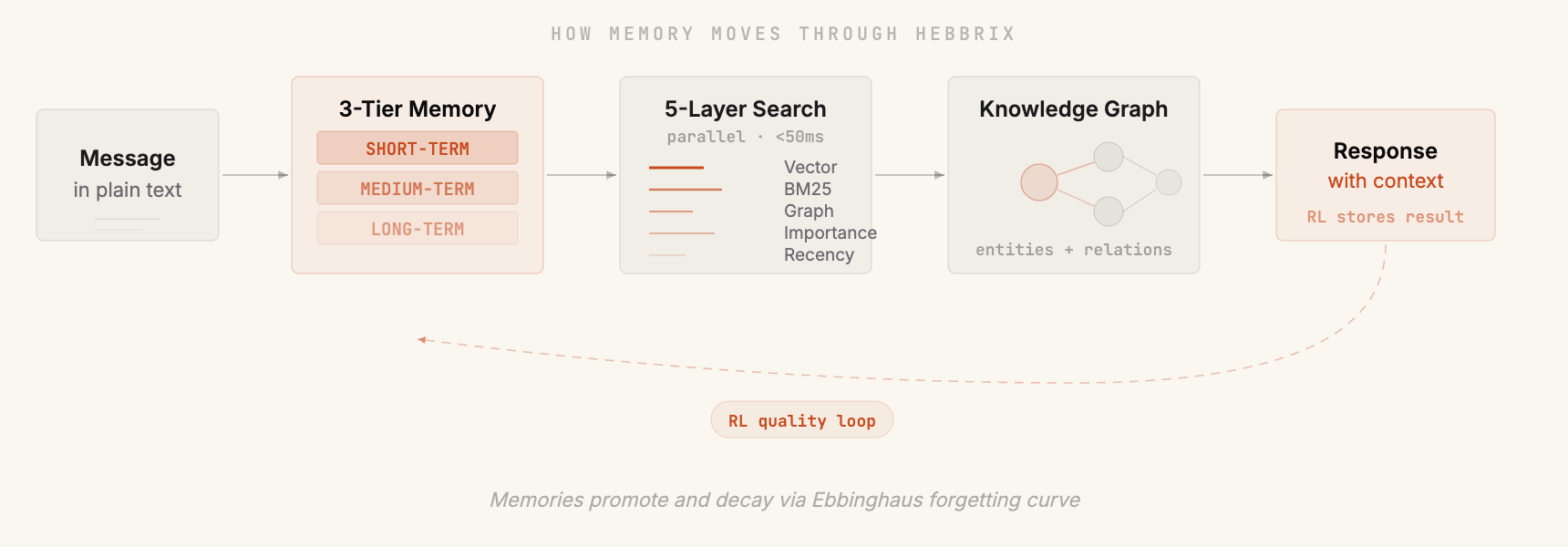
Versioned memory lifecycle
Current and superseded truth, operational tiers, provenance, corrections, retention controls, and explicit deletion instead of a flat vector store.
Adaptive hybrid search
Dense, sparse, graph, temporal, facet, and calibrated ranking signals adapt to each query and expose confidence and fallback metadata.
Automatic knowledge graph
Store plain text. Entities and relationships come out automatically. There's no schema to define and no extraction pipeline to maintain.
Outcome-aware retrieval
Explicit outcomes and relevance feedback can influence ranking. Improvement is workload-dependent and must be measured against a fixed baseline; it is not guaranteed after every interaction.
Collections and multi-tenancy
Keep memories separate per user, team, or scope. It's built into the architecture and maps to any data model without custom sharding logic.
Latency-aware retrieval
Adaptive dense, sparse, graph, temporal, facet, and calibrated ranking under published best-effort service objectives, with declared fallbacks.
Three principles behind every decision we make
Memory should be invisible infrastructure
You don't think about DNS when a webpage loads, and agents shouldn't need custom pipelines to remember things. The hard parts live inside Hebbrix, not in your code. If wiring up memory takes more than three lines, we haven't finished the job.
Cognitive science, not just vector math
Human memory has tiers, decay curves, and reinforcement loops. We modeled ours the same way, because that's what holds up in production. Flat retrieval and summarization aren't memory. They're a workaround.
Developer experience is the product
The API should feel obvious. The docs should answer the question you actually have. The errors should tell you what to fix. If it takes more than a page to store your first memory, the product isn't done.
"The best infrastructure is the kind you stop thinking about. You just trust it's there."
Built by developers, for developers, and meant to disappear.

Python & TypeScript
Type-safe, async-ready, and framework-agnostic. Run pip install or npm install and you're set.
OpenAI-compatible
Change one URL and memory starts working. Your existing SDK code stays exactly as it is.
Framework integrations
LangChain, LangGraph, CrewAI, Dify, and MCP. It fits whatever orchestration layer you already run.
Free tier
Generous limits and no credit card to start. Enough room to build and try it in production.
Company and support information
For legal-entity details, team information, procurement evidence or customer references, contact contact@hebbrix.com. We do not publish named customer references or funding claims here without permission.
See service status, terms, security disclosures and release notes. A contractual support response time or SLA applies only if separately agreed.
Give your agents a memory upgrade
Free tier. No credit card. Start building in five minutes.