Honest comparisons. No spin.
Four approaches to AI agent memory, each with its own trade-offs. Here's what each one does well, including where Hebbrix falls short.
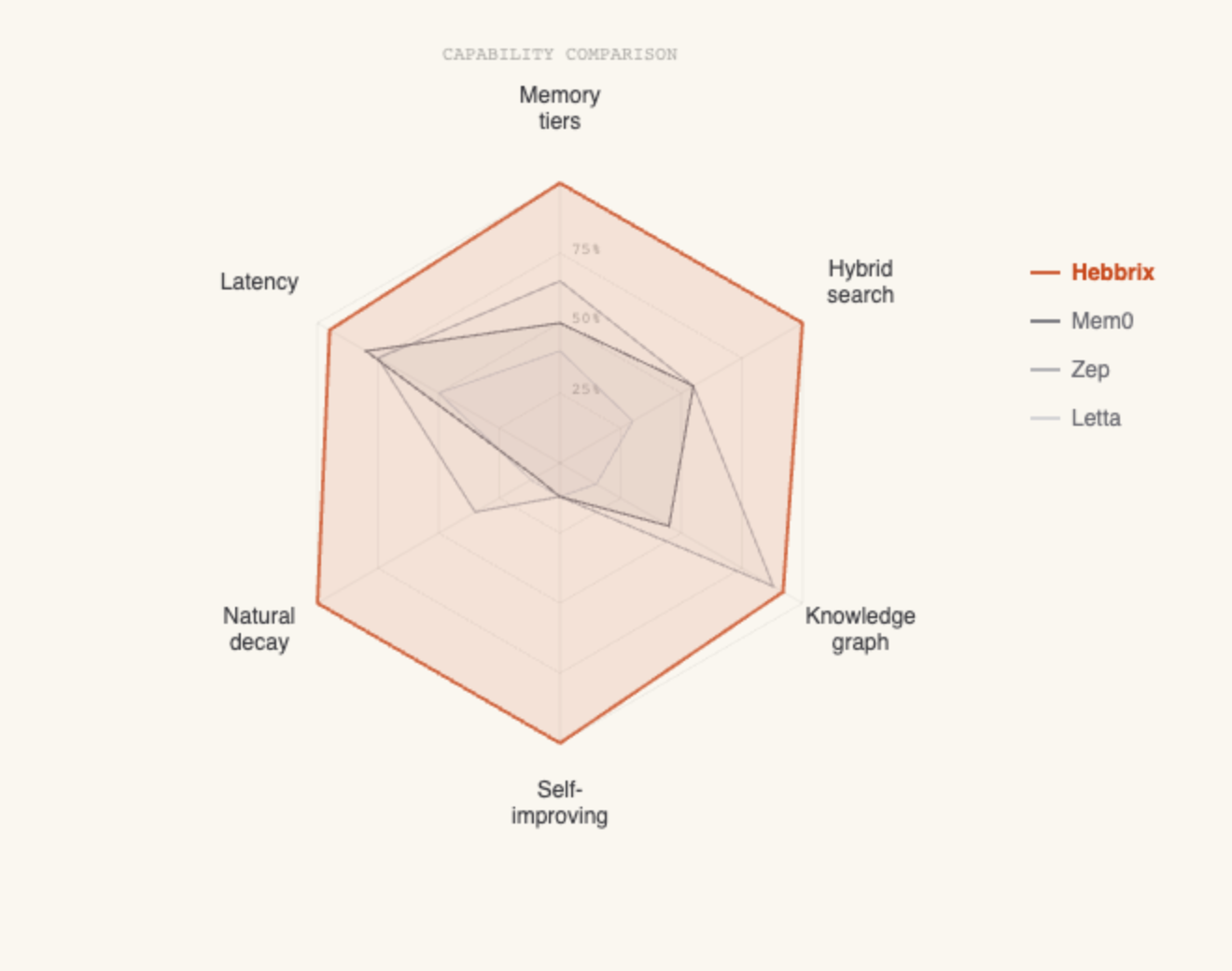
Feature comparison at a glance
Hebbrix vs Mem0
Mem0 is a widely-adopted open-source memory layer with a large GitHub following. Both store memories. The difference shows up in what happens to those memories over time.
Where Mem0 wins
Where Hebbrix wins
Bottom line: Both store memories. Mem0 is more mature and open-source. Hebbrix is the better fit if you want temporal memory plus explicit learning from reported action outcomes.
Hebbrix vs Zep
Zep pioneered temporal knowledge graphs for AI memory. Both care a lot about context, but they come at it from opposite directions.
Where Zep wins
Where Hebbrix wins
Bottom line: Two approaches to context. Both support temporal graph workflows; Hebbrix additionally packages adaptive retrieval and explicit action-outcome learning.
Hebbrix vs Letta
Letta (formerly MemGPT) is a full agent framework where the LLM manages its own memory. Hebbrix is a memory API. A framework versus a service is a fundamentally different choice.
Where Letta wins
Where Hebbrix wins
Bottom line: Letta is a full agent framework. Hebbrix is infrastructure. If you want to adopt a whole new architecture, choose Letta. If you want to add memory to agents you're already building, choose Hebbrix.
Hebbrix vs RAG alone
RAG is great for documents. Conversations, preferences, and relationships call for a different kind of memory. Most teams end up wanting both, not one or the other.
What RAG does well
What agent memory adds
Bottom line: Documents versus experiences. RAG retrieves from a knowledge base. Agent memory remembers what happened. You can run both, since Hebbrix connects to your existing docs connectors.
We're not going to pretend we're better at everything.
We don't have an open-source edition. We're newer than Mem0 and Zep. No SOC 2 attestation is published here; request current evidence. Compare each option against your requirements.
The most mature option, with the largest community. If you want open-source with a managed cloud option, SOC 2 compliance today, and you don't need automatic learning, it's a solid choice we respect.
Pioneered temporal knowledge graphs. If tracking how things change over time is central to your use case, Zep is purpose-built for it in a way no other tool matches.
A different philosophy, where the LLM manages its own memory. Maximum autonomy, fully open-source, and self-hostable. If you want to own the whole stack, Letta is the right call.
We're newer. We focused on temporal memory, adaptive hybrid retrieval, and explicit Outcome Memory with delayed results and uncertainty. The bet we're making is that agent memory should learn from measured outcomes without hiding the evidence. If that sounds right for you, give us a try.
Try the one that learns
Free tier, usage-based pricing, and no lock-in. See whether cognitive memory fits your agents.