AI memory infrastructure your security team can sign off on.
When you're running AI agents for thousands of users across departments, memory infrastructure is also a risk surface. Hebbrix is built to shrink that surface, not expand it. Isolation, auditability, and lifecycle management are part of the core architecture, not bolted on.
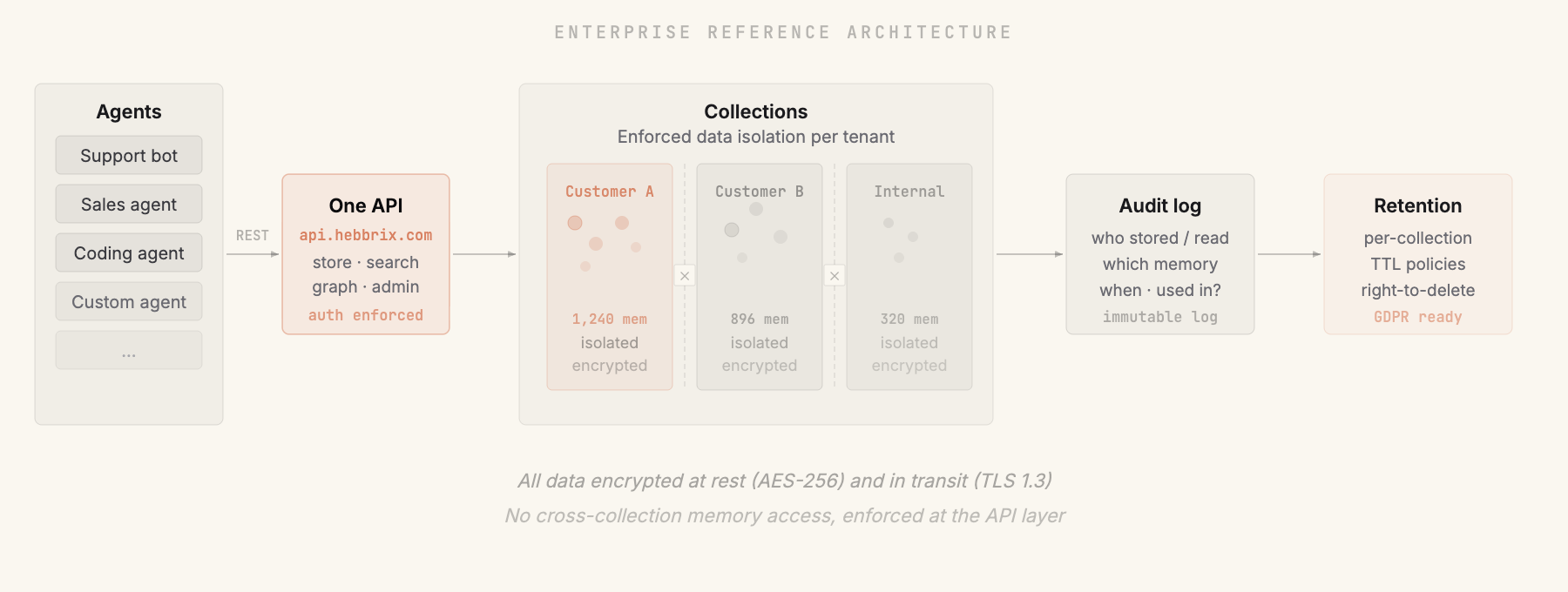
Every customer lives in their own memory space
Collections, ownership, and authenticated request scope form the tenant boundary. Treat cross-tenant isolation as a continuously tested security invariant across memory, search, graph, learning, and export paths.
Building a POC is one thing. Production is another.
At enterprise scale, memory infrastructure has requirements that don't show up in a prototype.
Customer A's data must not appear in Customer B's context. Collection, owner, and authenticated request scope enforce the boundary; test it continuously as a security invariant.
You're not building for one user. You're building for thousands, each with their own memory space, permissions, and data lifecycle. That has to work natively, not through sharding logic you write and maintain yourself.
Small-corpus latency is not enough. Benchmark p95/p99 across your corpus, tenant mix, and concurrency against the published best-effort service objectives.
Enterprise requirements are in the core architecture
Not bolted on. Not a checkbox on the pricing page. The architecture was designed with these requirements from the start.
Collections-based multi-tenancy
Every memory belongs to a collection. Collections enforce strict isolation. One API call creates an isolated memory space for any user, team, department, or customer. Serve 10,000 users from one instance without writing isolation logic yourself.
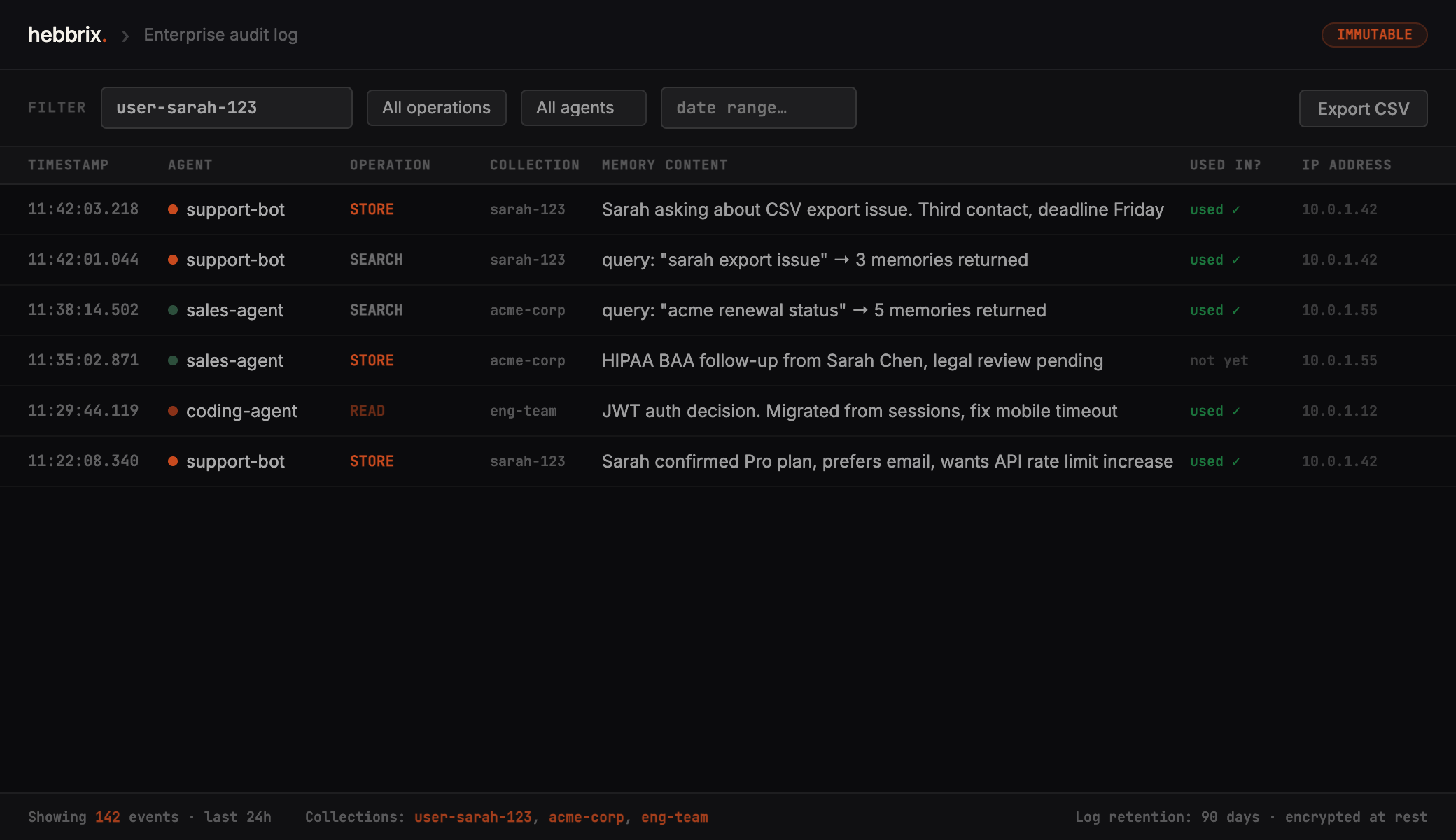
Full auditability
Every memory operation is logged. Know who stored what, when it was accessed, and how it was used in a response. When compliance asks "what data did this agent use?", you can answer it precisely instead of guessing.
Controlled data lifecycle
Operational tiers, temporal validity, supersession, and ranking signals organize memory without replacing retention policy. Pair them with explicit deletion and audit workflows.
Memory-level access control
Flexible scoping lets you define read, write, and search permissions at the collection level. Build role-based access, department boundaries, or customer-specific memory spaces. The API enforces it. Your application doesn't have to.
What you need. What we provide.
Let's talk about your architecture
Start with the free tier to evaluate. When you're ready to scale, we'll help you design the right setup for your compliance requirements and team structure.